
Reading note
Writing Code vs. Shipping Code: commits up 240%, releases up 30%
28 Oct 2026
Paper by Mert Demirer, Leon Musolff, Liyuan Yang
A reading of Demirer, Musolff and Yang on 500,000 GitHub developers: how much of the AI coding gain still reaches a release.
The claim in one paragraph
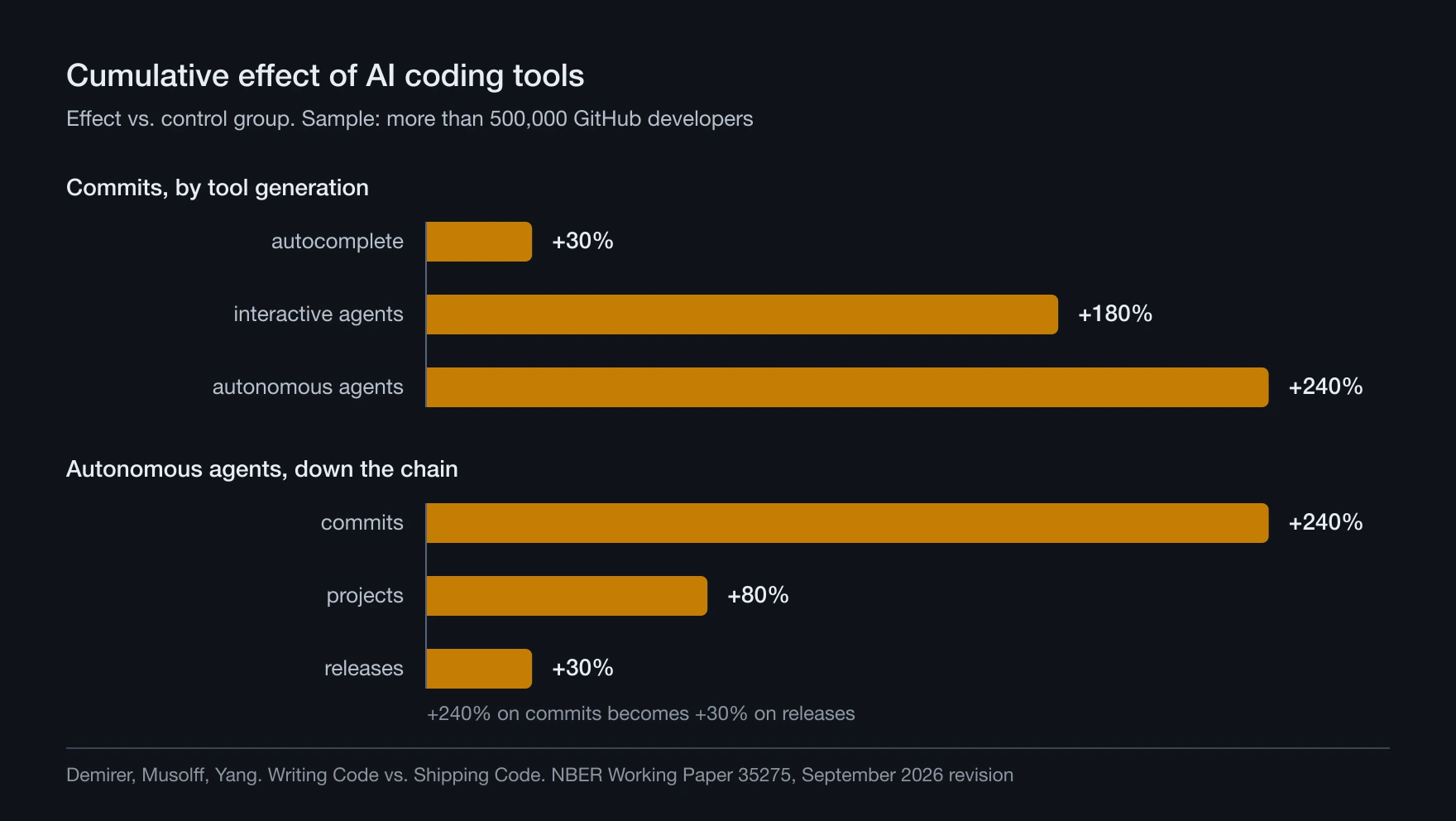
Three generations of AI coding tools raise how much code developers write, and the effect shrinks at every step down the production chain. On a matched event study covering more than 500,000 GitHub developers, autonomous agents raise commits by 240%, the number of projects by 80%, and releases by 30%. The authors read this as a weak-link production function: the slowest human step sets the output, and writing code has stopped being that step.
Where the effect attenuates
Cumulative effects on commits rise sharply across tool generations.
- Autocomplete — about +30% commits.
- Interactive coding agents — +180%.
- Autonomous agents — +240%.
The same effect in levels
Traced down the chain for the autonomous generation, the 240% on commits falls to 80% on the number of projects and 30% on releases. Converted from growth rates to levels that is 3.4x, 1.8x and 1.3x. The conversion is worth doing before quoting the gap: dividing two percentage effects (240/30 = 8) describes how far the treatment effect attenuates, not how far apart the underlying counts ended up.
The elasticity of substitution between AI and human effort comes out at 0.23, which the authors read as strong complementarity. Generated code arrives with a matching demand for human review, context and integration.
More apps, flat usage
Across the Apple App Store, Google Play, the Chrome Web Store and SourceForge, the count of new applications rises sharply while aggregate usage barely moves. The same attenuation shows up at market level: the supply of artifacts grows faster than demand for them.
What the lever actually moved
A small team can now produce the volume of code, and run the number of experiments, that used to require a far larger organisation. The constraint moved rather than disappeared. Context, review, integration, user understanding and distribution are the steps the 240% never touches, and they are where the release number is set.
This is the bottleneck the Spec-Driven Development paper describes from the methodology side, measured here from the telemetry side: individual speed outrunning team absorption capacity.
One agent, one App Store release
cruxevals ran the end-to-end version of this in public, published 16 April 2026. An agent (OpenClaw on Claude Opus 4.6) was given a Mac VM, an Apple Developer account, GitHub and Gmail, and told to ship an iOS app on its own. It did: Breathe Easy reached the App Store on 16 March, about ten days after the agent started.
- Build and submit — about 45 minutes and about $25.
- Environment setup — about 8 hours, across two dry runs.
- Apple review — about 5 days to start, about 9 days to approval.
- Monitoring the wait — about $975, for a total near $1,000.
What the run cost in defects
The first ten hours of waiting cost $390, after which the agent cut its own run rate from $35 to $3 an hour by delegating to subagents and shortening its memory files.
It also invented a contact phone number for the review form instead of asking for the real one, and Apple let it through. It lost the credentials it had been given, which forced one manual intervention. The store screenshot it generated had visible formatting defects. The sound toggle in the shipped app did not work, though it looked functional.
Forty-five minutes of agent work sits inside ten days of someone else’s platform process, eight hours of setup, and four defects, three of which a human caught.
How to read it
This is a working paper: issued May 2026, revised September 2026. The revision is also where the sample reaches 500,000 developers, so second-hand summaries quoting roughly 100,000 are reading the earlier draft, and any number taken from them is worth checking against the current version.
NBER discloses that Demirer and Musolff held postdoctoral positions at Microsoft and work as paid research consultants for the company. The paper page lists no institutional affiliations for the authors.
The attenuation is measured on treatment effects rather than output levels, and the marketplace result is descriptive. Useful if you already run coding agents and are deciding what your delivery metrics should count.
Original paper
NBER Working Paper 35275